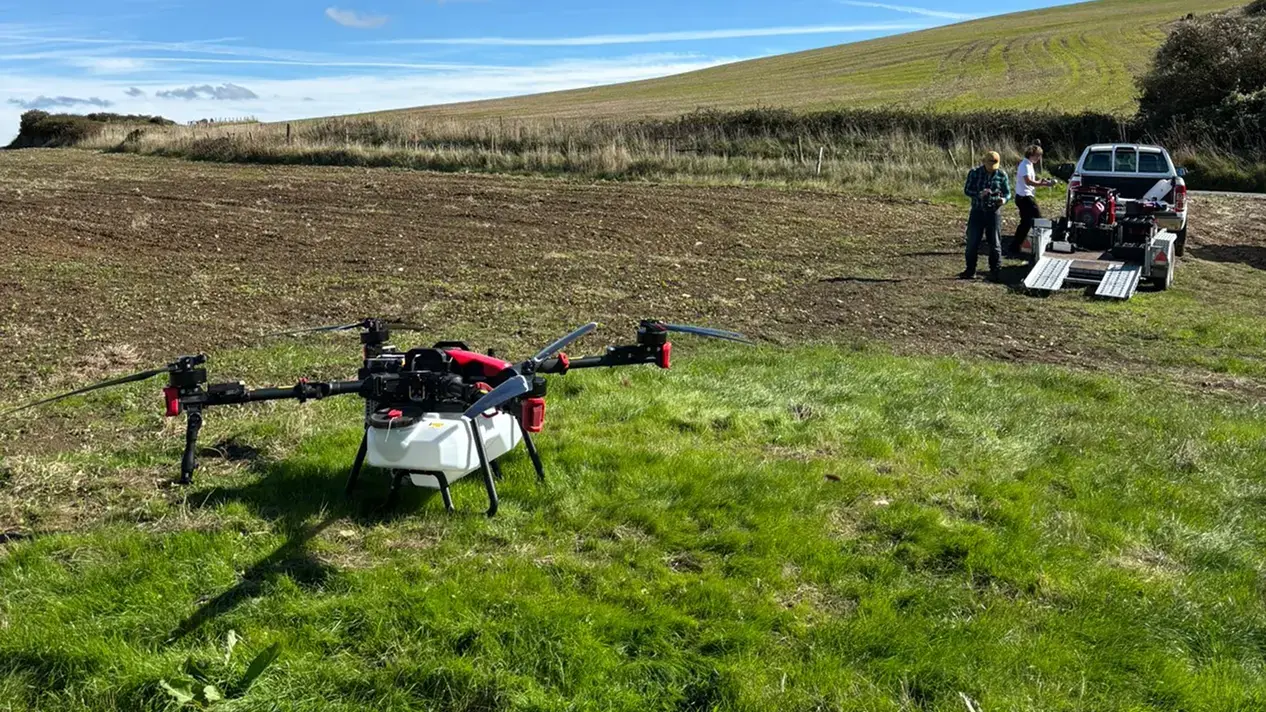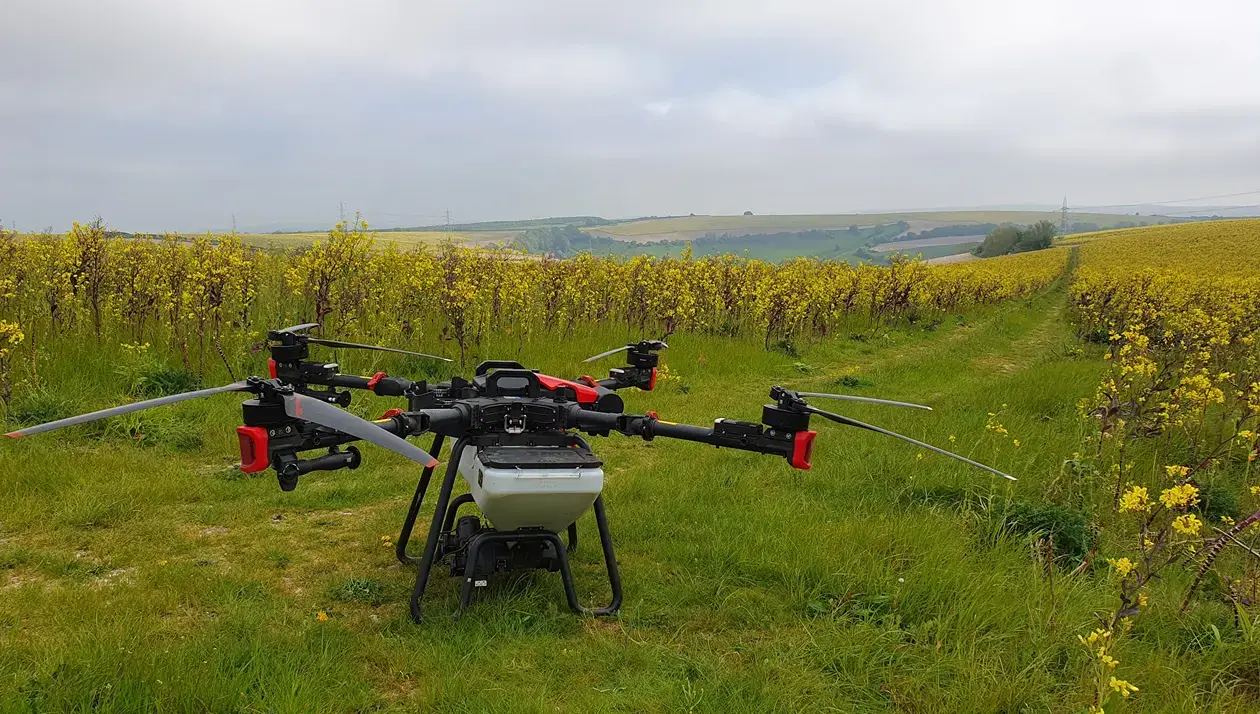
Drone spraying supports regenerative agriculture by enabling precise, low-disturbance delivery of cover crop seed, biological insecticides, and biostimulants without the soil compaction caused by conventional machinery. In the UK, CAA-authorised operators can now apply a growing range of biological and foliar inputs by drone - directly serving the core regen principles of minimal soil disturbance, continuous soil cover, and natural inputs.
Ask a UK farmer whether drones can spray pesticides, and there's a fair chance they'll say no - that it's still not permitted here. That answer was accurate a few years ago, and it is now wrong. By summer 2025, regulatory approvals expanded to include biological insecticides, with herbicide and fungicide authorisations moving steadily along the same trajectory. Most of the farming press hasn't caught up. Several agri-drone websites still haven't updated their FAQs.
That stale picture matters, because drone spraying and regenerative agriculture are more closely aligned than most UK farmers currently realise. The five core principles of regen farming - as defined by the British Ecological Society's 2025 report and Parliamentary POST Note 748 - aren't in conflict with precision application technology. At several points, they actively point toward it. And with SFI26 now putting real money behind measurable regen outcomes, the question isn't whether drone application has a role in your system. It's which role it should play first.
What Regenerative Agriculture Actually Means in a UK Context
The most authoritative UK framework comes from Parliamentary POST Note 748 (June 2025) and the British Ecological Society Regenerative Agriculture Report 2025, which together identify five core principles: reduce soil disturbance, limit bare soil, promote on-farm diversity, integrate livestock, and prioritise natural inputs.
One clarification worth making early: regenerative farming is outcome-led, not input-restricted. Unlike organic certification, it doesn't prohibit specific products - it asks whether your practices are genuinely improving soil health, biodiversity, and long-term land function. That distinction matters when herbicide use under no-till systems comes up, as it shortly will.
The momentum behind regen farming in the UK is substantial. Attendance at the Groundswell Regenerative Farming Festival grew from 450 in 2016 to over 8,000 in 2024. DEFRA's Environmental Land Management Scheme - and SFI26 in particular - is directing significant public money toward farms that can demonstrate measurable, evidenced delivery against these principles. AHDB research reinforces the direction: soil health and biodiversity outcomes are increasingly central to how UK agricultural policy values land management.
The Five Regen Principles - and Where Drone Application Fits
No competitor content has mapped these two things together at the principle level. Here's the synthesis.
Principle 1: Reduce Soil Disturbance
The no-till transition comes with a paradox that advocates don't always surface early enough: removing the plough often increases herbicide use in transition years, because tillage previously managed the weed burden that now needs another solution. POST Note 748 addresses this directly - regenerative agriculture can involve using chemicals as an alternative to ploughing to manage weeds.
Precision spot treatment by drone is the operational answer to this trade-off.
RTK (Real-Time Kinematic) GPS navigation - operating with centimetre-level positional accuracy - allows a drone to treat identified weed patches rather than blanket-spray an entire field because a problem exists somewhere within it. Total herbicide load falls. Soil structure remains intact.
There's a second compaction risk that's easy to underestimate: the sprayer itself. Running a fully-laden tractor and boom across wet autumn ground is a bit like pressing your whole bodyweight onto a soil profile that's just starting to breathe again - the structural gains from no-till get compressed before they've had a chance to develop. A drone at maximum payload creates no meaningful ground pressure, regardless of conditions.
Principle 2: Limit Bare Soil - Cover Cropping
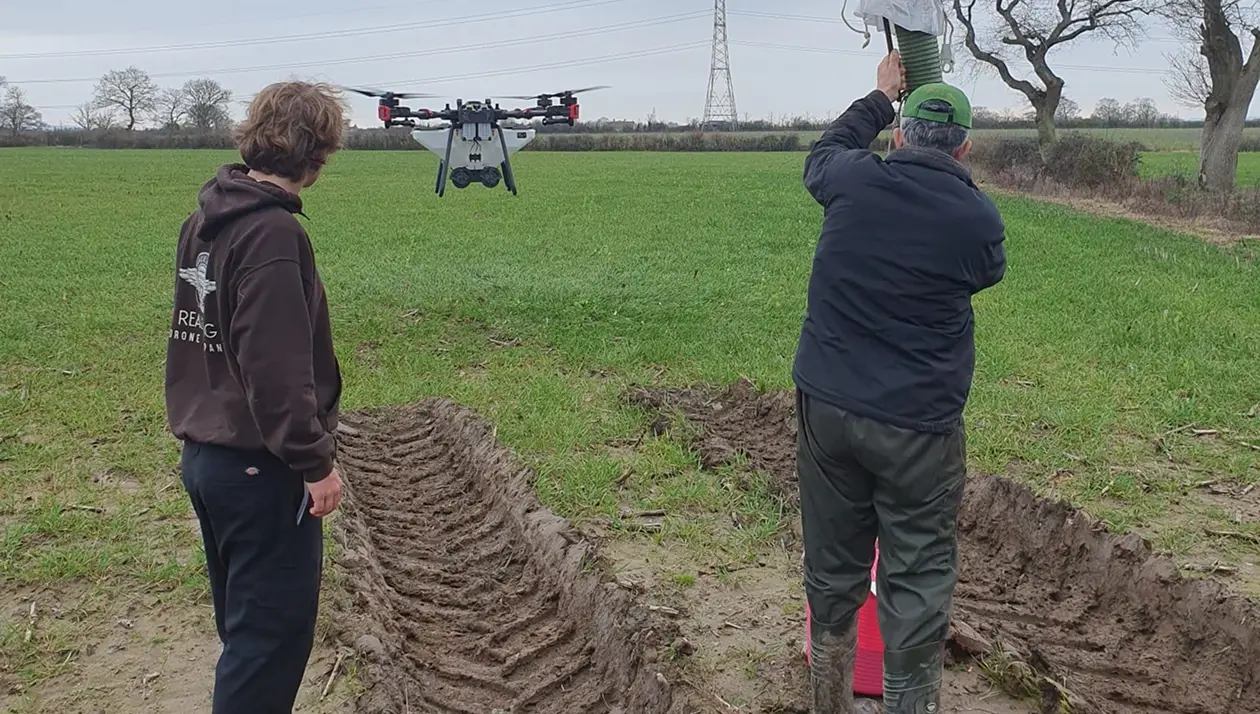
Cover cropping has the strongest evidence base of any regen principle, and it's where drone application has the most established UK track record. The challenge with cover crops isn't the principle - it's the timing window. Pre-harvest undersowing needs to go into standing crops before the combine arrives. Post-harvest broadcasting needs to happen before soils cap and moisture is lost. Both windows are narrow, and both tend to coincide with exactly the ground conditions that make running heavy machinery most damaging.
Drones cover approximately one hectare every five to seven minutes, over standing crops or saturated ground, with no access constraints. The fuel comparison alone is instructive: cover crop establishment by tractor uses around 17 litres of diesel per hectare. Contracting-in drone application saves roughly £23-25 per hectare on fuel - before tractor depreciation and operator time enter the equation.
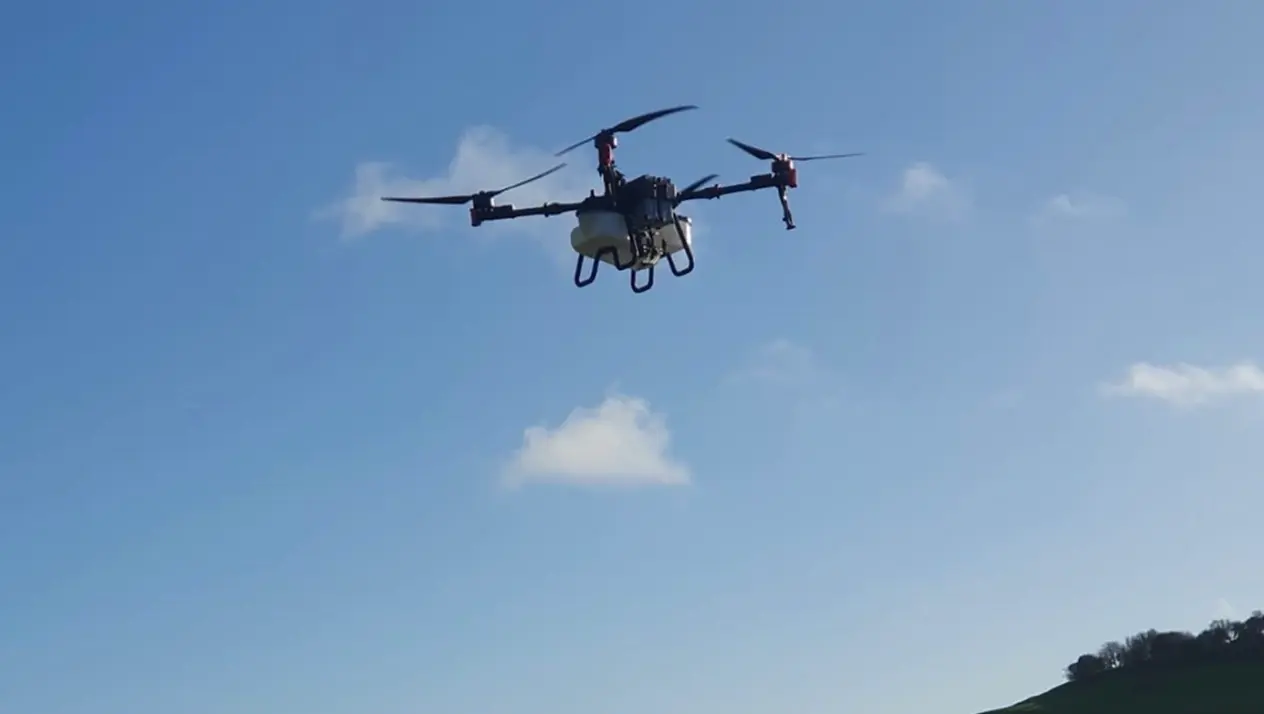
Farmers who've made the switch describe a consistent experience. One Norfolk grower, quoted in industry coverage after their first drone cover crop operation, summed it up well: the drone caused no soil disturbance, no compaction, and the living root stayed in the ground throughout - which is precisely the outcome the whole exercise was designed to achieve. For SFI26, where cover cropping is a core delivery action, drone-applied seed also generates GPS-timestamped, rate-verified records that satisfy scheme evidence requirements in a way an undocumented tractor broadcast never will.
Principle 3: Promote On-Farm Diversity
Biodiversity enhancement - wildflower margins, beetle banks, agroforestry understorey, multi-species grass mixes - tends to need establishing in exactly the places ground machinery reaches least easily: steep banks, wet corners, woodland edges, awkward headlands. Drone seed broadcasting handles all of these with the same ease as a flat, open field.
ELMS habitat enhancement actions within SFI26 reward measurable, evidenced interventions. A drone-broadcast wildflower margin with a verified seed rate and GPS-mapped coverage gives an estate manager the audit documentation the scheme expects. A bag tipped from a tractor cab in a wet October leaves no comparable trail.
Principle 4: Prioritise Natural Inputs
This is where the most significant content gap in the competitive landscape sits - and where drone application is arguably most directly aligned with regen principles.
Biological pest management is increasingly central to regen systems: beneficial nematodes, mycorrhizal inoculants, biostimulants, foliar micronutrients, and biological insecticides. These products work best when delivered with precision and minimal disturbance to the soil biology they're designed to support. A drone running Controlled Droplet Application (CDA) technology delivers exactly that - targeted, low-volume application using UK REACH compliant products that protects living soil biology while treating only where treatment is required.
Under the CAA's 2025 Operational Authorisation expansion, UK-authorised operators can now apply biological insecticides by drone - a development that's barely registered in mainstream farming media.
Combined with multispectral NDVI (Normalised Difference Vegetation Index) surveys that identify pest or disease stress patches before they develop into field-wide problems, this is Integrated Pest Management (IPM) functioning the way the textbooks describe it. Rather than setting off every alarm in the building because you suspect smoke somewhere, you're identifying exactly where the heat is coming from and responding only there.
Principle 5: Integrate Livestock
Drone application is less central here, but it's not absent. Grass reseeding on heavily poached paddocks, fodder crop establishment on wet ground, and applying soil amendments to areas where tractor traffic would cause further structural damage all represent genuine, if supporting, applications. For mixed farms, drone services complement the livestock system in specific operational moments rather than transforming it wholesale.
The SFI26 Financial Case - What Regen Farming with Drone Support Could Earn
Regenerative farming under SFI26 is a revenue stream. A 200-hectare arable farm with cover cropping, no-till management, and precision nutrient applications could be looking at over £45,000 a year in scheme payments - and the quality of your application evidence directly affects eligibility.

The cover crop establishment comparison for a 200ha farm:
| Approach | Approx. cost/ha | SFI26 evidence quality |
|---|---|---|
| Tractor broadcast (dry conditions) | £25-45/ha incl. fuel, machinery wear, operator time | Variable; difficult to audit retrospectively |
| Drone contractor | £30-50/ha | GPS-verified, rate-confirmed, audit-ready, digitally mapped |
The drone option isn't always the cheaper line item in isolation. Factor in avoided compaction remediation, reliable access in marginal autumn conditions, and the evidence trail that SFI26 delivery actions depend on, and the picture changes substantially.
Precision variable-rate drone application also reduces crop input costs. Treating only the areas that genuinely require treatment - rather than uniform blanket coverage - typically delivers a 30-50% reduction in inputs applied across a field. On a 200ha farm spending £80/ha on crop protection, that's a meaningful saving. Soil Organic Carbon (SOC) accumulation under precision-managed regen systems is also increasingly relevant to carbon market participation - a revenue line that didn't exist for most UK arable operations five years ago.
What UK Drone Spraying Can (and Can't) Currently Do
The most persistent piece of misinformation in UK agri-drone content is that drone PPP application remains unavailable here. By summer 2025, this had changed substantially, and it's worth being precise about where things stand.
Currently permitted under a CAA Operational Authorisation (OA UAS):
- Biological insecticides and beneficial organisms
- Foliar feeds, biostimulants, and micronutrients
- Cover crop seed, wildflower seed, and tree seed broadcasting
In progress:
- Conventional herbicides and fungicides - authorisation pathway advancing in line with the 2025 regulatory trajectory
- Molluscicide (slug pellet) application - approval expected
All legal drone spraying in the UK requires a CAA Operational Authorisation and the relevant HSE and DEFRA product approvals for each application type. Navigating this process takes months - which is why the practical route for most farms is to work with an operator who already holds all required permissions. Drone Spraying UK carries full CAA authorisation and arrives on-farm ready to operate. There's no licensing complexity, no equipment to procure, and no multi-month approval process on the farmer's side.
What We See on Regen Farms
The pattern across farms transitioning to regenerative practices tends to be consistent. Autumn is where drone contracting earns its place most decisively.
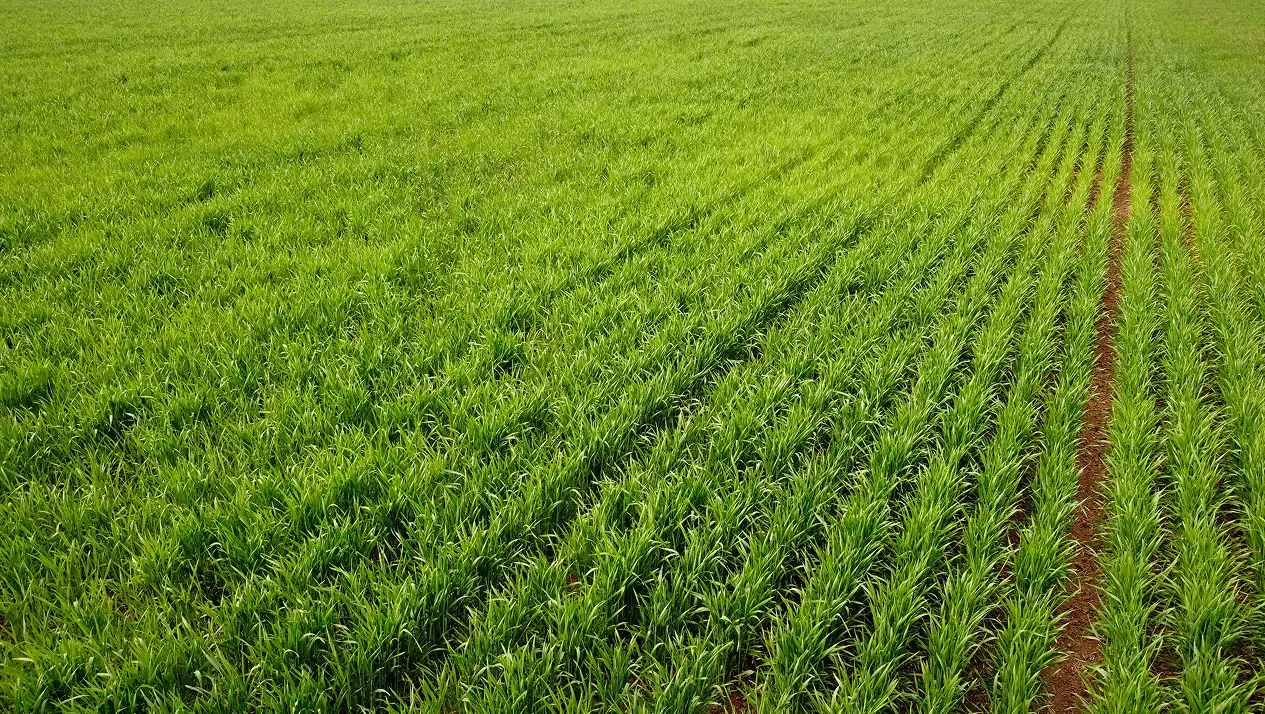
On a mixed arable operation transitioning to no-till, the cover crop window closes when ground conditions deteriorate - often in the same fortnight the cereal harvest has just finished. Running a heavy drill or broadcast spreader at that point undoes the compaction remediation the whole transition was designed to protect. An XAG P100 Pro with RTK navigation and terrain-following radar - or a DJI Agras T100 on larger-area operations - has no such constraint. A multi-species cover mix (brassica, legume, phacelia) goes in at a consistent, verified rate regardless of what the soil surface looks like.
What we consistently hear from agronomists after a first drone operation is a version of the same thing: the conversation shifts from "is this worth doing?" to "how early in the season should we book it?"
The SFI26 application records the operation automatically generates tend to reinforce that view.
Is Drone Spraying Right for Your Regenerative System?
Farm Types That Benefit Most
The strongest operational fit tends to be: arable farms transitioning to no-till with autumn access constraints; mixed farms with inaccessible grassland or poached winter paddocks; estates managing diverse habitats under SFI26; soft fruit and horticulture operations where soil trafficking causes direct crop damage; and any farm where precise, GPS-evidenced application records support scheme payment claims.
Honest Limitations to Consider
Drone spraying operates within wind speed parameters - typically under 15 mph - so weather windows matter and scheduling needs to account for this. For large-scale blanket applications in good conditions on firm ground, conventional kit can still compete on unit cost. The drone delivers the greatest value at the intersection of precision, access constraints, and compliance documentation.
The five regenerative principles aren't a checklist in tension with precision technology. Mapped properly, drone application services actively support each one - and in the case of soil disturbance, cover cropping, and biological inputs, they remove practical barriers that slow regen transitions down. The farms that find that transition most straightforward are consistently the ones that treat precision tools and regenerative principles as part of the same system.
SFI26 is making the financial case for regen farming increasingly hard to set aside. Farms that delay building the evidence trail those scheme payments require may find last season's cover crop operation wasn't documented in a way that holds up to scrutiny - and that window doesn't open again until autumn.
Working out whether drone application fits a specific farm system is a conversation, not a commitment. Drone Spraying UK works with farmers and agronomists to identify which operations on their land are the strongest candidates - no capital outlay, no equipment to source, no CAA authorisation to navigate. See our services or get in touch with the team to discuss what's practical for your land, your rotation, and your SFI26 position.