Foliar fertilising is the practice of spraying liquid nutrients directly onto a crop's leaves rather than applying them to the soil. Plants absorb these nutrients through stomatal openings and the leaf surface within hours - far faster than root uptake through soil. It is used as a targeted supplement to, not a replacement for, conventional soil nutrition.
Here's something that surprises most people the first time they hear it: a plant's leaves can feed it faster than its roots can. Apply the right liquid nutrient to the leaf surface and the crop absorbs it within hours. Apply the same nutrient to the soil and you might wait days or weeks - assuming the soil even co-operates. That gap in speed is the entire logic behind foliar fertilising, and it's why you'll find it written into professional agronomy programmes for everything from winter wheat to oilseed rape.
How Does Foliar Fertilising Actually Work?

Nutrients applied foliarly enter the plant through stomata - the microscopic pores on the leaf surface - and through the cuticle of the leaf epidermis itself. Once inside, they move directly into the phloem and are distributed to wherever the plant demands them most at that moment.
What makes this particularly useful is what it bypasses. Soil-applied nutrients can get locked up by pH imbalance, compaction, waterlogging, or simply cold ground temperatures - all common enough in a UK spring. Foliar application sidesteps all of that entirely. The nutrient goes straight to where it's needed, without negotiating with the soil first.
Which Nutrients Are Best Suited to Foliar Application?
Micronutrients are the primary candidates.
Manganese, boron, zinc, copper, and molybdenum are all routinely applied foliarly in UK arable - and for good reason. Manganese deficiency is a persistent problem in cereals on lighter, high-pH soils; boron is critical to oilseed rape at the rosette and green bud stages, when demand spikes and soil supply often can't keep pace.
Nitrogen can also go on foliarly, and this is where the efficiency argument becomes compelling. AHDB trial data shows that foliar nitrogen applied to OSR at late flowering - when the crop has largely stopped taking up N from the soil but still needs it for pod and seed fill - can be cost-effective at around 40 kg N/ha when the cost-to-crop-price ratio stays below 3.0 to 3.5.
Sulphur and magnesium are both commonly included in foliar programmes for UK cereal crops, often tank-mixed with fungicide applications. Product lines such as YaraVita are formulated specifically for this kind of targeted foliar work, using chelated micronutrients that remain available on the leaf surface long enough to be absorbed.
When to Apply - and Why Timing Changes Everything
The window matters almost as much as the product. Foliar applications work best in cooler, humid conditions - early morning or evening, when stomata are open and temperatures are below around 18°C. Push it in the heat of the afternoon and you risk scorching rather than feeding.
For UK arable crops, the critical windows are worth noting:
- Cereals: tillering through to flag leaf, roughly GS25-GS39, captures the period of highest nutrient demand and greatest leaf area for absorption.
- Oilseed rape: the rosette stage for boron; late flowering for supplementary foliar nitrogen when soil uptake tails off.
- Grassland: early spring, when soil temperatures below 5°C make root uptake largely ineffective. Farmers Weekly trial data from Nigel Howells Consultancy found that 60-70% less nitrogen applied via the foliar route achieved comparable grass dry matter yields versus conventional compound fertiliser - a meaningful efficiency gain.
Professional operators factor all of this into their spray planning. Timing, conditions, product selection, and application rate are managed together - they're not independent variables.
How Is Foliar Fertiliser Applied?

The traditional method is a tractor-mounted boom sprayer: reliable, widely understood, and effective on accessible ground. The limitation is everything it can't do - it can't work on waterlogged fields without compacting them at sensitive growth stages, can't reach steep or irregular terrain easily, and follows fixed tramlines regardless of what the NDVI data says.
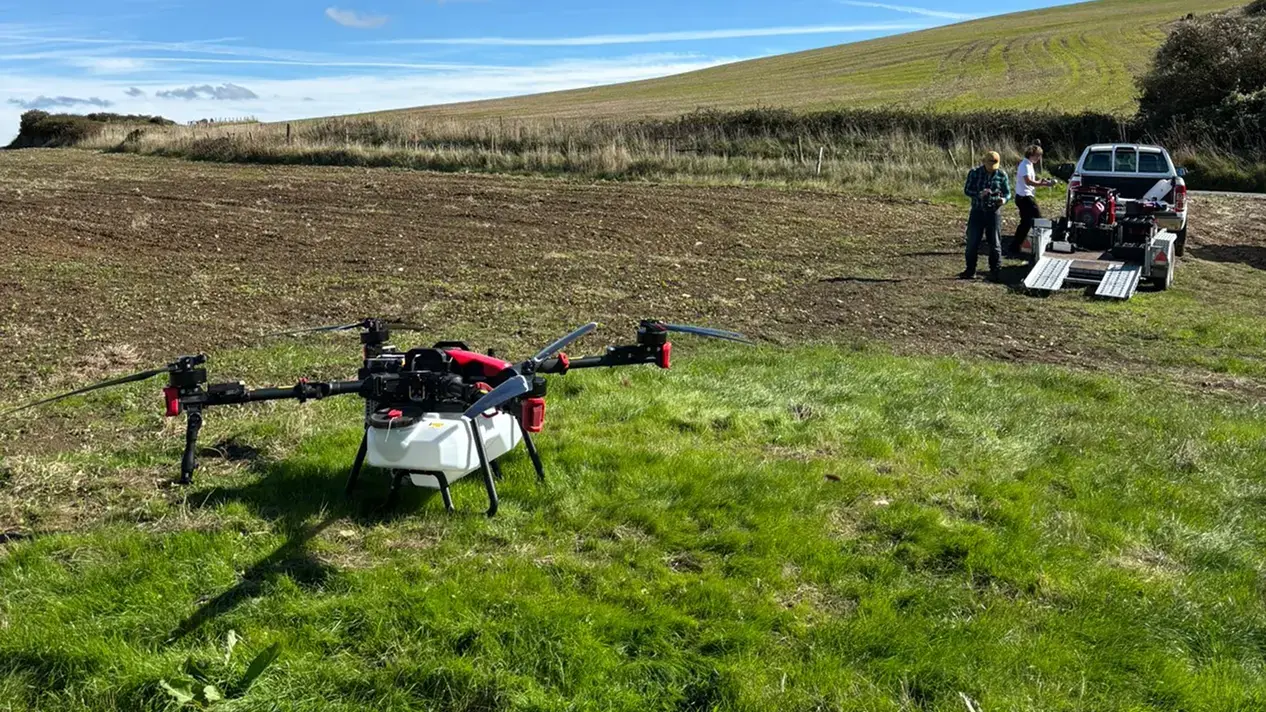
Agricultural drones - such as the DJI Agras T100 or XAG P100 Pro - are increasingly used by professional operators for precisely this kind of foliar work. They apply low-volume, high-concentration foliar sprays without ground contact, which matters most when soil conditions are marginal and timing is critical. Variable-rate application based on multispectral data means nutrients can be placed only where the crop actually needs them, rather than applied uniformly across a field that isn't uniformly deficient. All commercial drone application in the UK is carried out by CAA-authorised operators working with UK REACH-compliant products.
Foliar fertilising is one of the most targeted tools available to UK growers. The way it's delivered is now almost as important as what goes in the tank.
For the full picture on drone-applied crop nutrition and whether it suits your land and crop type, our guide to drone spraying for UK arable farmers covers the detail in depth.
If you'd like to talk through a specific crop or timing window, get in touch and the team at Drone Spraying UK can advise. You can also see our services to understand what drone application looks like in practice.